The Men Behind the Markers
_edited.jpg)
Passing by the Nevada County Depot and Museum, one may notice two white granite markers along with the civil war memorial to soldiers who fought at Prairie D’Ane. Erected by the American Legion November 11, 1954, these markers memorialize the 100 Federal and 50 Confederate lives lost at Prairie D’Ane. The April 1864 battle at Prairie D’Ane, also known as the Battle of Gum Grove, was the turning point in General Frederick Steele’s march to Shreveport. Steele’s initial plan was to join forces with General Nathaniel Banks at Shreveport, capture the Red River port city, and open a route to ship cotton from Texas to textile mills in the north.
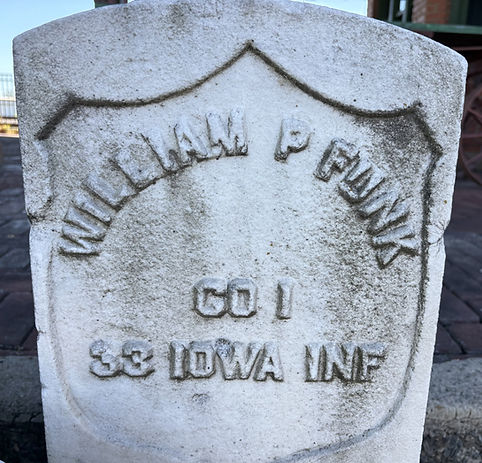

Drawn not only to stop and read the markers’ messages, my interest was piqued about the soldiers themselves, the men whose lives were cut short yet memorialized in stone: Erasmus D. Lockman, William P. Funk. A third memorial headstone of Edward H. Bates is missing. A psychologist by profession and a novice history buff, I wanted to learn more about these three. Who were these men behind the markers? Enlisting the aid of Robbin Ridgell, registrar of the local Pat Cleburne Chapter #31 of the UDC and a whiz at searching through military records, we respectfully share the results of our online searching and FOLD3 document reviews.
Erasmus Dowel Lockman was born September 4, 1836 in Medora, Indiana, the third of five children. His grandfather Vincent Lockman was a Revolutionary War veteran who served as private in the North Carolina Infantry. In 1858, Erasmus married Rebecca Webb and they had no children. She began receiving a widow’s pension in June 1864. FOLD3 records show Lockman’s mustering in date as October 8, 1861. He was a private by rank with Company A, 50th Indiana Regiment, Infantry, who notably fought in Kentucky, Tennessee, Alabama, and Arkansas. Total loss of the 50th Indiana during the war was 218 with 161 from disease, the remaining 57 from combat/wounds. Erasmus Dowel Lockman, age 27, was one of the 57, killed in action April 11, 1864 during the Battle of Prairie D’Ane.
William P. Funk was also a private, serving in Company I of the 33rd Iowa Infantry with whom he enlisted August 9, 1862 in Knoxville, Iowa. Private Funk is said to be the first casualty at Gum Grove, aka Prairie D’Ane, being wounded on April 10, 1864 and succumbing to injuries on April 12. An account from A History of the 33rd Iowa Infantry Volunteer Regiment, 1863-1866 by A.F. Sperry provides the following April 10, 1864 details from Prairie D’Ane:
At about 4:45 p.m., as we came upon the edge of the prairie, the continuous skirmishing merged into a battle,
and the artillery firing became quite heavy. A piece of shell struck Private Wm. P. Funk, of Company I,
wounded him in the head so that he died in a few hours. There was no other casualty in our regiment during
the battle.
Had Pvt. Funk not been a fatality of this battle, it’s possible he, like many of the 33rd Iowa, would have been killed just a few days later on April 30 at the hard fought Battle of Jenkins’ Ferry.
The missing marker is that of Edward H. Bates who held the rank of corporal with Company F, 27th Wisconsin Infantry. He was killed in action at Gum Grove on April 10, 1864. Born in Canada in 1838, the 1860 Wisconsin census shows him residing and working as a farm laborer for John Mitchell. Bates enlisted August 15, 1862 and participated in the Siege of Vicksburg, the capture of Little Rock, and the Camden Expedition. The May 2014 online edition of Jerry McKelvy’s Sandyland Chronicle paid tribute to the 150th anniversary of the Camden Expedition, and in the narrative gave mention of the three memorial markers. As previously mentioned, the markers were placed by the American Legion in 1954 on the roadside of the Blevins highway near a field owned by A. B. Stewart. The placement there resulted from local knowledge that the three soldiers were buried within half a mile of where the memorial markers were set. Controversy resulted over the placement of Union casualty markers and ultimately vandalism occurred in the form of Edward Bates’s memorial marker being stolen. Subsequently, the remaining markers were moved in 1978 to where they now sit at the Nevada County Depot and Museum.
Article contributed by:
Dr. Deborah Wilson
Robbin Ridgell


The Missing Marker
The missing marker is that of Edward H. Bates who held the rank of corporal with Company F, 27th Wisconsin Infantry. He was killed in action at Gum Grove on April 10, 1864. Born in Canada in 1838, the 1860 Wisconsin census shows him residing and working as a farm laborer for John Mitchell. Bates enlisted August 15, 1862 and participated in the Siege of Vicksburg, the capture of Little Rock, and the Camden Expedition. The May 2014 online edition of Jerry McKelvy’s Sandyland Chronicle paid tribute to the 150th anniversary of the Camden Expedition, and in the narrative gave mention of the three memorial markers. As previously mentioned, the markers were placed by the American Legion in 1954 on the roadside of the Blevins highway near a field owned by A. B. Stewart. The placement there resulted from local knowledge that the three soldiers were buried within half a mile of where the memorial markers were set. Controversy resulted over the placement of Union casualty markers and ultimately vandalism occurred in the form of Edward Bates’s memorial marker being stolen. Subsequently, the remaining markers were moved in 1978 to where they now sit at the Nevada County Depot and Museum.
Article contributed by:
Dr. Deborah Wilson
Robbin Ridgell